Embedding Visualizer
PIDSMaker ships an interactive 3D web viewer for exploring a run's node embeddings in the browser. A Flask server reads the artifacts a run already produced and serves a Three.js front end; it is independent of the pipeline — you generate the data for a run, then open it in the viewer.
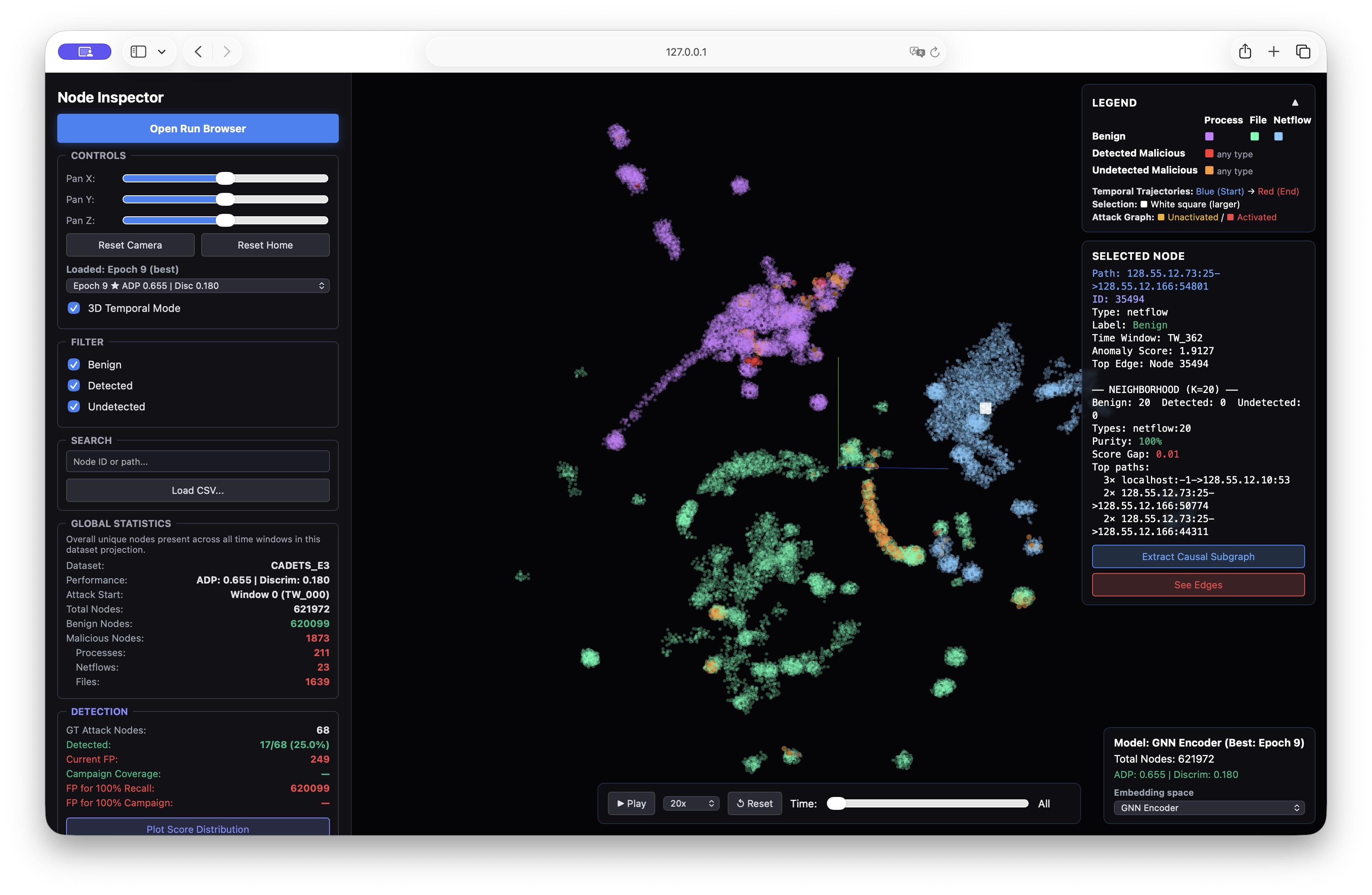
It renders the per-node embeddings (UMAP or t-SNE projection) and supports:
- Temporal playback — points appear and fade with their time window.
- Per-node inspection — click a node for its path, type, label, anomaly score, and a K-nearest-neighbour analysis; extract its causal subgraph or incident edges.
- Two embedding spaces — switch between the featurization space and the GNN encoder space, with an epoch selector for the encoder.
- Overlays — temporal trajectories, the attack graph, a discrimination heatmap, and false-positive highlighting.
Running the viewer
Start the server inside the container:
python -m pidsmaker.vizgen.web.viz_server
Then open http://127.0.0.1:5000. The last run you viewed loads automatically; use
Open Run Browser (top of the left panel) to pick another. When viewing from
another machine, tunnel over SSH (ssh -N -L 5000:localhost:5000 <user>@<server>).
Tip
If localhost is refused but 127.0.0.1 works, the server is bound to IPv4
only (--host 0.0.0.0) while localhost resolves to IPv6; start it with
--host :: to serve both.
Generating viz data for a run
A run needs an embedding export before it can be opened. The easiest path is the in-browser Run Browser → Generate button; you can also generate from the CLI:
python -m pidsmaker.vizgen.web.export SYSTEM DATASET --embeddings both
Opt in when training: --save_for_viz
Generation is fastest and most complete when the training run pre-saved the extra artifacts the exporter reuses — the per-epoch model checkpoints (for the GNN-encoder space and epoch selector) and a cached copy of the test graphs. These are large and most runs never open the viewer, so they are off by default and enabled per run:
python pidsmaker/main.py SYSTEM DATASET --save_for_viz
Enable it on the runs you intend to explore. Without it, a run is still discoverable and you can still generate viz data, but the featurization space works normally while the GNN encoder space needs the checkpoints (skipped with a warning if absent), and the test graphs are recomputed on demand.
More details
The web viewer has its own README covering the run browser, generation options,
buffer/streaming design, and endpoints:
pidsmaker/vizgen/web/README.md.